A Better Guide to Annotating Your Books
Some advice/a guide for annotating books, with examples!

NOTE: THIS ESSAY CONTAINS SPOILERS FOR “INTERVIEW WITH THE VAMPIRE” AND “DUBLINERS”
I am writing this because it is what I would've have wanted when I first began to annotate my books. There are many essays, videos, and even books on how to annotate, but they all seem more focused on the physical act of annotation rather than the mental act. The videos I watched at least were more about when to write, what pens to use, what highlighters you need, how to make a color code for tabs, etc. What I aim to do, and would like to see more people talk about, is the mental steps you need to take when annotating.
Annotation is not the easiest thing to start doing. That may sound discouraging but it's true. While it is very easy to pick up a pencil and start writing in the margins, figuring out what to write is a bit trickier. It's something that you need to practice, as silly as it sounds.
So, more for my younger self and any autistic scholars like me who might need more direction, here is my guide to annotating books.
First, materials. You can use whatever you want.
Pens, pencils, highlighters, markers, sticky notes, tabs, etc. Whatever makes you happy and excited to read is exactly what you need.
If you would like my opinion on it, here it is; pick one pen. The fewer materials you use the more streamlined your annotating will be. It is easy to get lost in making sure you are using the right color tab or highlighter, and carrying a whole pen case with you to annotate can get tricky. So a single pen is best.
And it must be a pen, no pencils. The permanence of a pen is perfect for annotation. It makes you think about what you really want to say and it makes sure that your marginalia (the things you write in the margins) harder to fade/get erased. Of course if you don't want to write on your books in pen (or, as in my case, have more to say than there is space for) you can use sticky notes.
There are, in my view, two ways to annotate. You can annotate 'casually' or 'in-depth.' Both are valid ways to annotate. What I am calling casual annotation is still a deeper reading of the book, rather it is just a way to annotate on your first pass through the book. In-depth annotation is more academic and more focused on getting every possible bit of info out of the book that you can. With this method you will always start by reading the book through once with just your brain, no annotating. This first step to in-depth annotation is the same regardless of the genre.
CASUAL
For a more casual annotation (the one I most often do with books) you don't need to read it more than once. You can dive in with your pen in hand.
There are two major things I look for when annotating; what I am feeling and what the book is trying to tell me.
What am I feeling? is a question that I ask literally. It's more so something that allows me to put sillier annotation down. Not every annotation needs to be a paragraph about the hidden meaning behind what a character has said. Sometimes you write just write 'lol' and that's it. Part of annotation is capturing the experience you had reading it, especially with the casual method. Because this is (theoretically) your first time reading the book, its valuable to record even the small things you are feeling because you will never be able to read this book for the first time again. As much of a bummer as that is.
What is the book trying to tell me? This question is not as simple as the first. Books tell you many things, some are explicit some are not, are *implicit.* If you don't know, implicit (as I'm using it) is the subtext that the author has included in the text. It's the infamous "why are the curtains blue?" Explicit points or events in the text do not need to be annotated. These points are static and will always come across to you the same; if a dog jumps in the book, you will know that a dog jumps the first time reading just the same as you will the fifth time. Implicit points are more likely to change and be interpreted differently throughout your life as you change and grow as a person.
Lets see an example of a book I annotated casually;
Firstly, the following are examples of "What am I feeling?" (from Interview with the Vampire by Anne Rice)
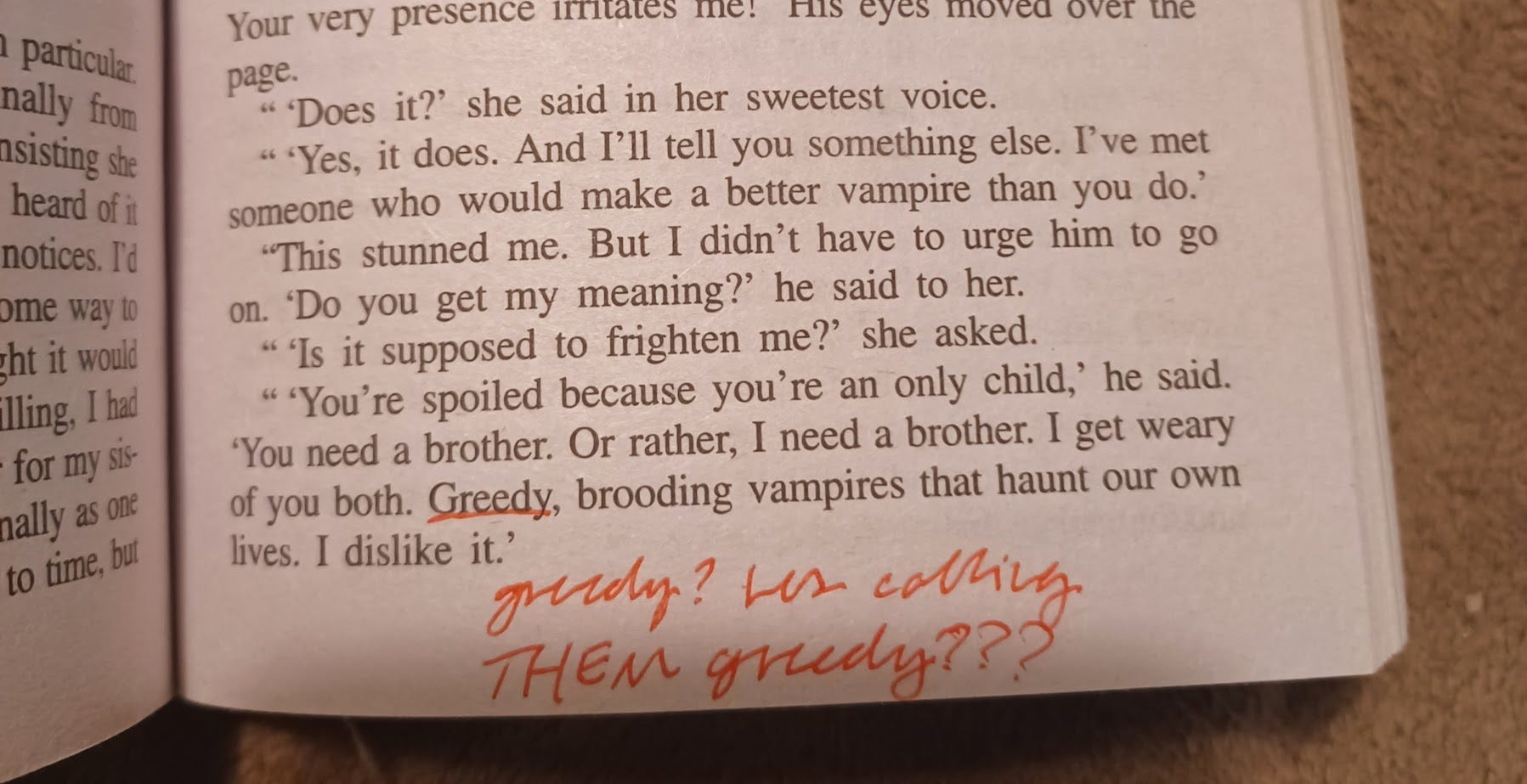
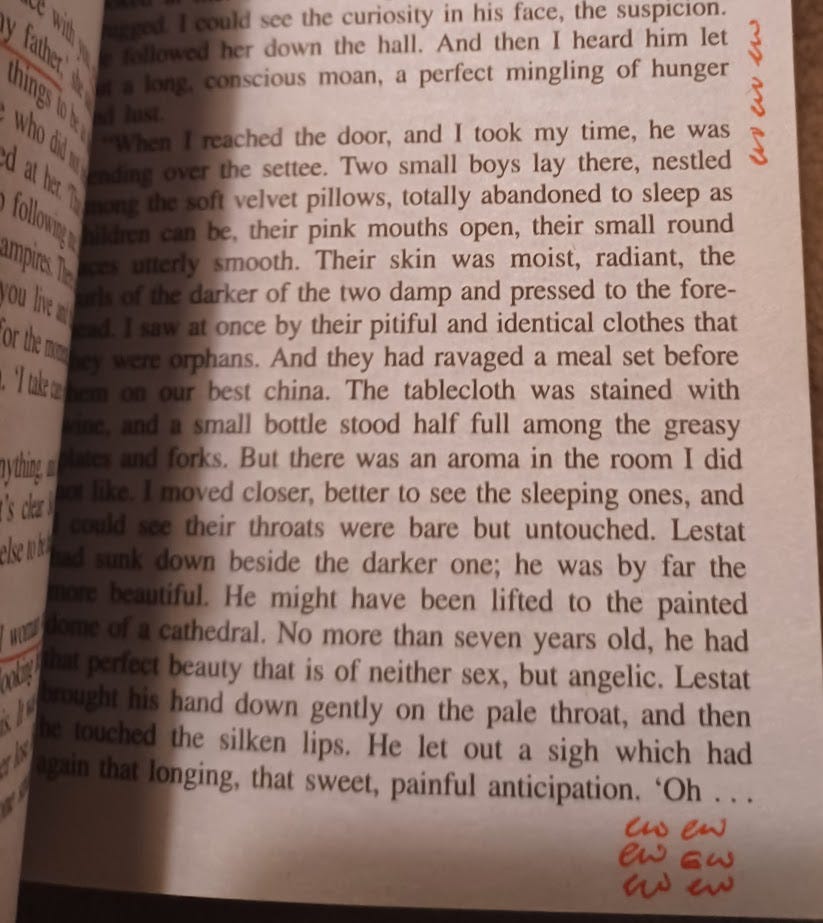
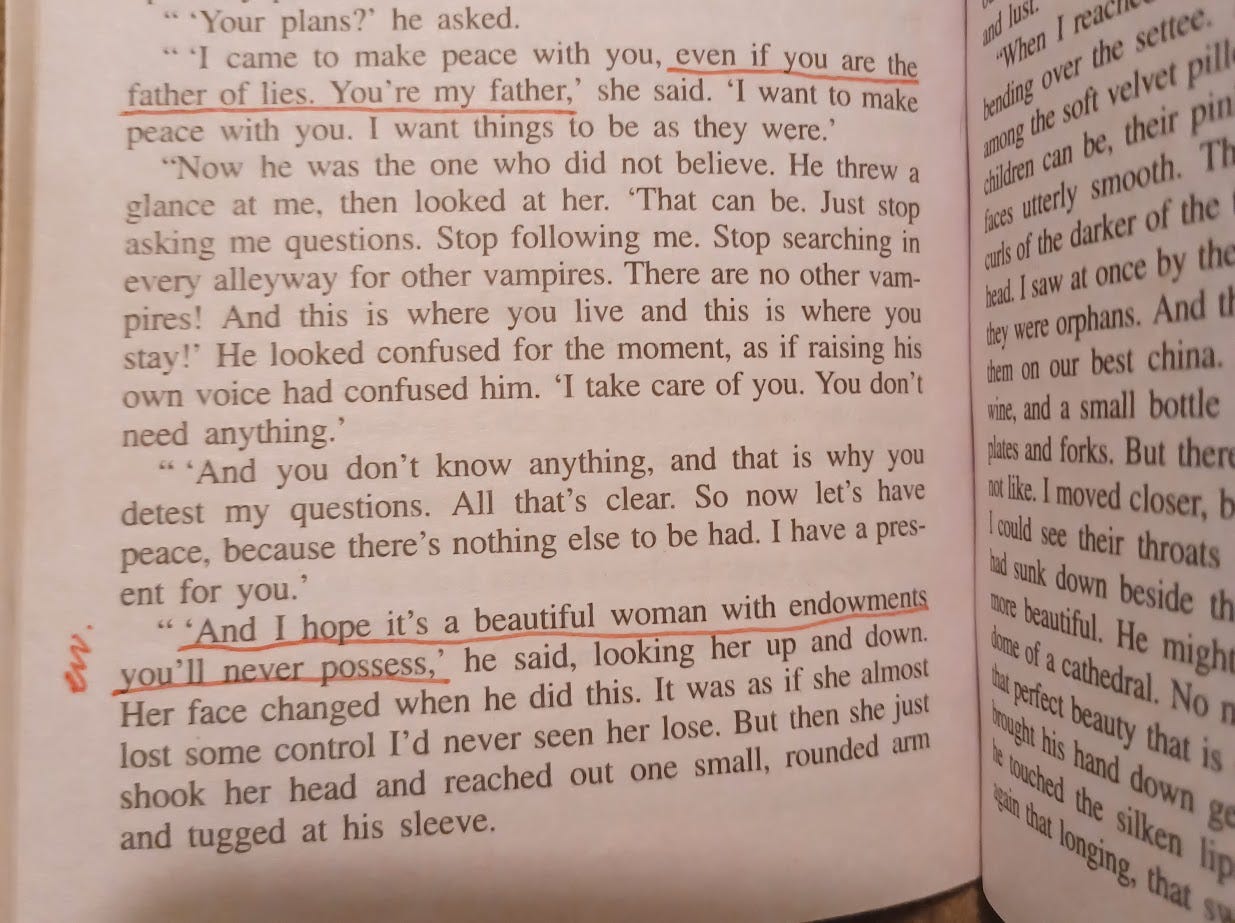
Overall there is not much substance to these annotations. They are just my gut reactions to the things I am reading.
Now, the below are examples of "What is this book trying to tell me?"
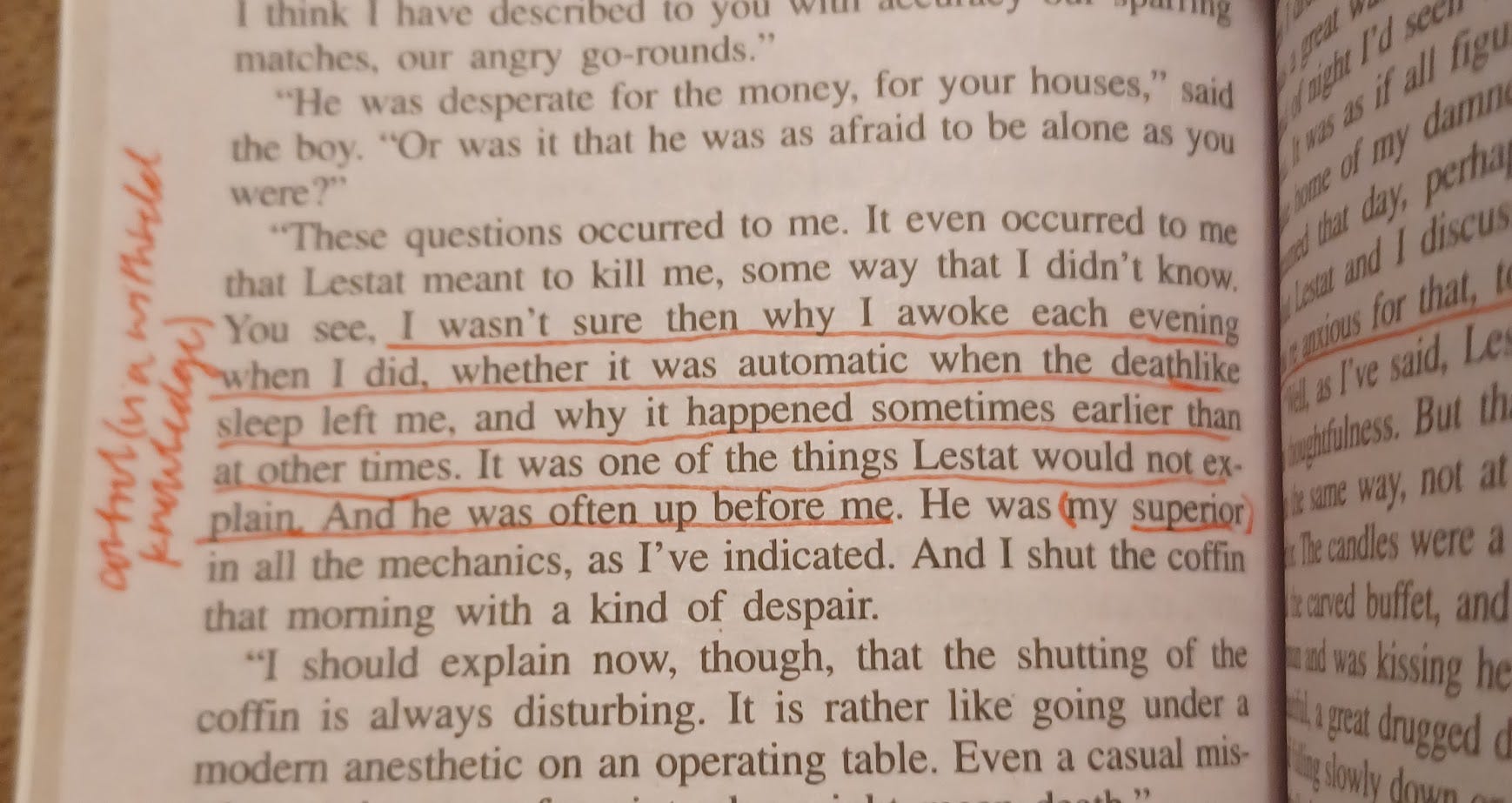
In this scene of the book the boy interviewing Louis is asking follow up questions about the time Louis and Lestat lived together, on Louis's plantation.
Louis is describing what his days were like after becoming a vampire, how he felt. The implicit information that I noticed in this passage is that Lestat was very likely keeping Louis with him, controlling him, by withholding knowledge about being a vampire. My annotation says "control(via withheld knowledge)". I agreed that Lestat was afraid to be alone, this portion of text told me how Lestat was preventing that.
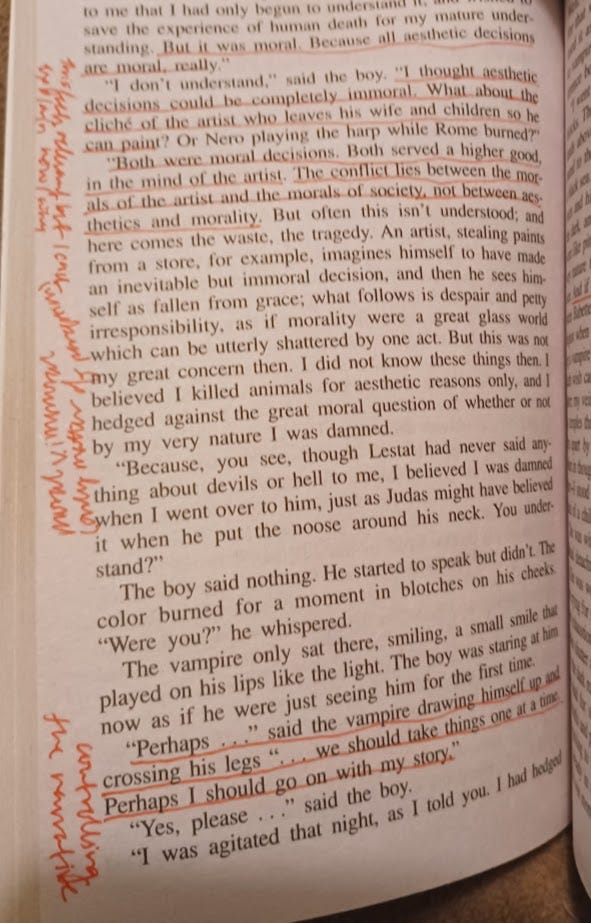
There are a few annotations here; The first at the top of the left reads "this feels relevant but I cant explain why". Which is another completely valid thing to write. Sometimes the author writes something that screams out to you but you lack the words or knowledge to know why it stood out, that's okay! Not everyone will write out something, opting to just underline it, but its still something you can make note of.
The next annotation reads " moral vs immoral (only a matter of perspective)." This is a response to the paragraph that starts with 'Both were moral decisions.' It's the point that I think is being made by the statement, written out simply. I'm sure when I reread this in the future, I'll have a different understanding of this.
The last annotation, at the very bottom, reads "controlling the narrative." It is a response to Louis taking control of his story with the line "[...] we should take things one at a time." Here I have noticed that Louis seems very particular about how his story is told, this gives me incite into his character and his personality in a way that isn't explicitly shown in the text.
These annotations are more in-depth than the ones about my emotions but they lack a connecting theme or point. They are just thoughts that I have and things I have noticed withing the text while reading.
All in all casual annotation is great if you are reading for fun but still want to be able to have good discussions about a text. It also serves as a sort of time capsule that you can return to and see how much you have grown and changed since you last read a piece of work.
IN-DEPTH
This style of annotation is more time consuming and for those who really want to understand the innerworkings of a book. It's more of an academic style of annotation but I think its still beneficial to do an in-depth look at books even if you aren't in school.
With this style you have one goal; question everything.
In order to question a work you have to have a base understanding of it, that is why you need to read through it once without your pen. Experience the story as it is and without the need to pick it apart, that comes later. Once you know the form of the story you will be able to read it a second time and notice even more than you did before. It's similar to how watching a mystery a second time can cause you to go "oh!! It's was obvious the whole time!"
Go into your second reading with a main question. What's something you noticed while reading? What does the author do that you find intriguing? What are a certain characters motivations? etc. Having a main question or topic you'd like to explore will help you narrow down what you are annotating. In-depth annotation is to get everything you can out of a book, having a question will help you unlock many of its secrets.
Another helpful thing, that isn't necessary but will improve your understanding more, is to research the book and the author. When was it written? What was happening during that time? Did anything big (wars, famines, etc.) affect the author while writing this book? Who is the author? What did they believe in? At what time in their life did they write this work? All of these questions and more can help you look behind the curtain and discover more of the WHYs about the book. Here is my copy of Dubliners by James Joyce, I've written another essay about a different work of his but I no longer have that book. (If you'd like to see a deep analysis of a book check out the essay!) Specifically, these are two pages of the story 'Eveline':
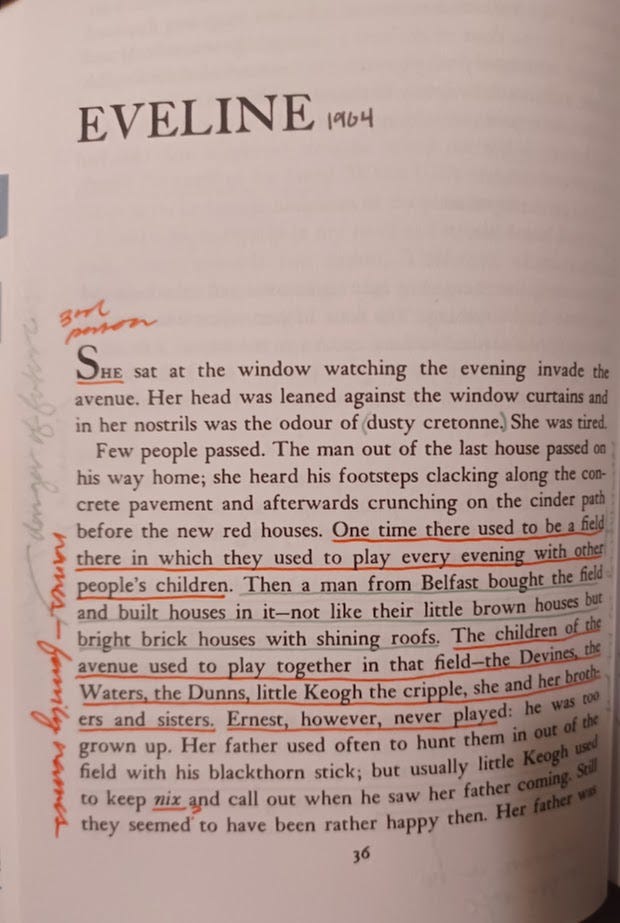
You'll see it better on the second page I show but I actually read this story three times, the first with no pen, the second with red, the third with the gray green.
At the top by the title I have written the year it was written. Not published, written. Eveline was written during the year that James Joyce fell in love with his partner, Nora.
The first thing I noticed while reading what that the entire story was in the third person. This was notable because the first three stories of the book are in first person. It was a signal of change in the narrative and overarching pattern of the stories. The next thing I note was that many names were said, a lot of them family names rather than first names. The last thing on this page that I noted on my second read was an unfamiliar word.
On my second read I did not have a question that I wanted to ask the work. I was just noting what stood out to me. During my third read I had a question, more of an idea; the story is about a teenager and her struggles with the future and moving forward from her current point in life. Why does she struggle? What is stopping her from moving on with her life?
The only note on this page from my third read is that 'the man from Belfast' is a figure that represents change. He is given no name and comes from a faraway place, both things that can be dangerous for small children; just as the future seems dangerous to Eveline.
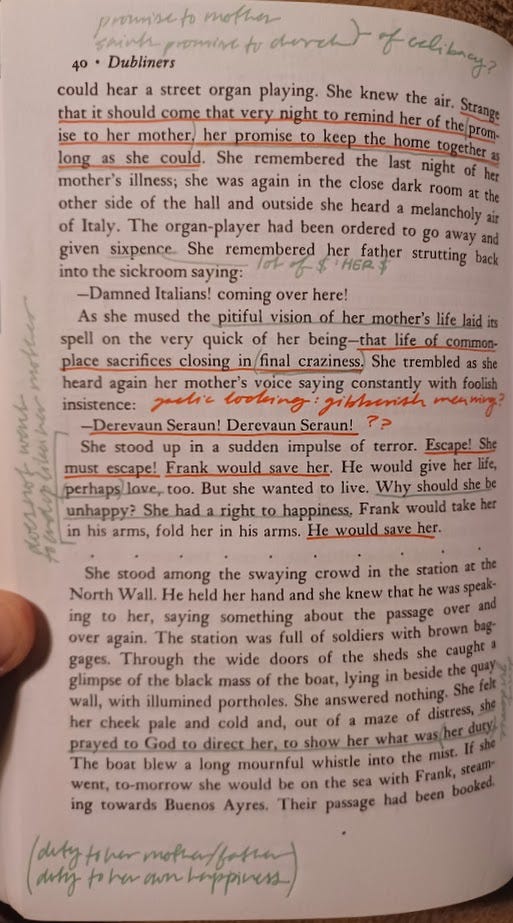
This page is about the death of Eveline's mother. On my second read I had marked the line about her promises to her mother. This turned out to be helpful on my third read because it is one of the reasons Eveline is so scared of moving on. As I wrote above, this promise is a parallel to the promise of celibacy made by a saint mentioned earlier in the story. Both promises are of innocence, moving on with her life (and with her lover) Eveline would be moving away from the innocence of her childhood and thus breaking her promise.
I also noted that Eveline wants to move on because she does not want to be like her mother. She does not want to end up with the same life as her; 'that life of commonplace sacrifices closing in final craziness.' She yearns for the future yet is paralyzed by it when facing it head on (at the end of the story Eveline is about to move away to another country with her lover but backs out last minute.)
All of my green annotations are looking for the theme of the future and the duality of wanting to move on but being scared by the unknown of it all. I was able to sort through all of the bits that would not help me understand the theme better.
CONCLUSION
Casual annotation is much easier and more for fun reading, you are just marking down how you feel and anything that stands out to you about the story as you are reading. In-depth annotation takes more time and requires you to question everything you are reading, through the lens of a question or theme of the story that you would like to explore.
I hope that my guide, and examples, helped make things a bit clearer. I tried to be as understandable as possible but if there are questions let me know. Of course there is no one 'correct' way to annotate a book. If you hate the way I do it and have shown that's ok! There are many ways to annotate and engage with a book. In fact, my annotation is very different in fiction than in non-fiction or with poetry. The goal of annotation is to create and record your experience with a book and understand it better. If colorful tabs and 12 pens helps you do that, go for it! If annotating would make things more confusing, that's ok too! If I helped at least one person figure out annotating, then my goal is achieved.
Happy reading!